Be Curious. Be Cosmic. Look Up!
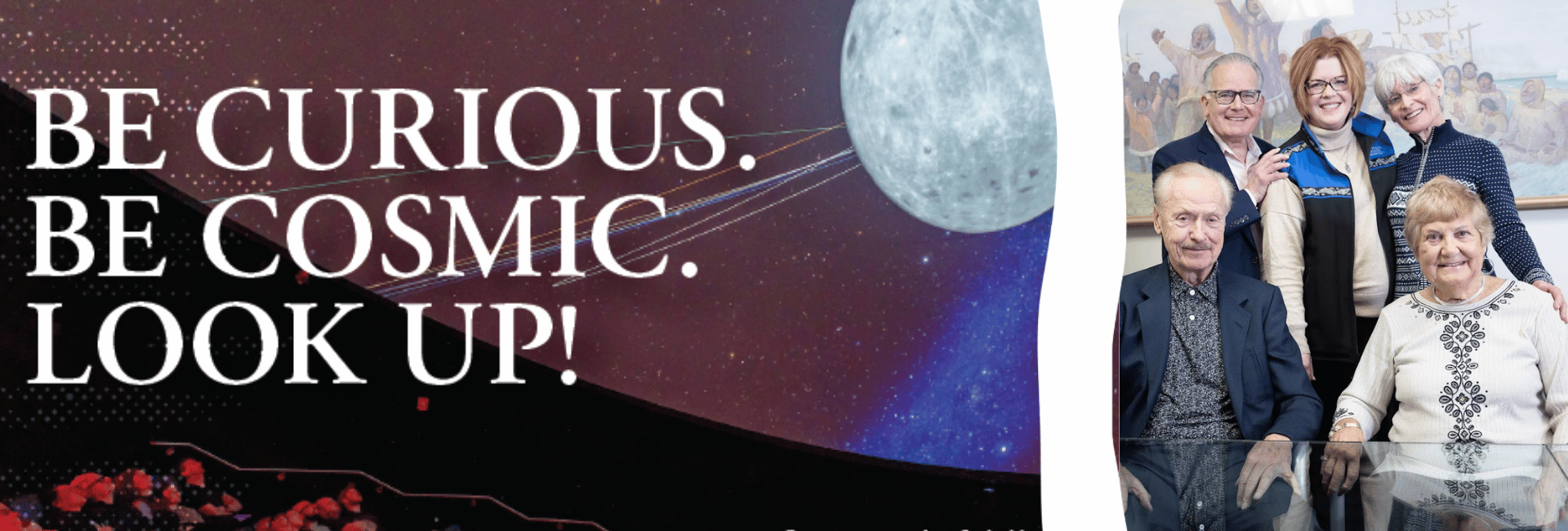
These words guide visitors to a beautifully dim, dome-shaped space inside the UA Museum of the North’s newest addition: the Walt and Marita Babula Planetarium. As guests enter, a shared sense of awe and wonder fills the room as they find themselves surrounded by the Babulas’ generosity.
Walt and Marita Babula gave $7.4 million to create the planetarium, the largest gift from living donors in the University of Alaska’s history. Their leadership inspired others to give, turning a long-held dream into a reality. As visitors settle into their seats, quiet murmurs fade and eyes turn upward. Crisp, immersive visuals transport audiences across time and space, while rich sound deepens the experience, made possible by the equipment that was funded by the M.J. Murdock Charitable Trust and the University of Alaska Fairbanks Geophysical Institute.
Every detail of the experience is thoughtfully orchestrated, thanks to the leadership of a dedicated planetarium director who is fully funded for the first two years by Sarah and Cary Keller.
Additional contributions from Davis Constructors and Engineers Inc., RESPEC, and Michael and Lynn Rice helped launch the project.
The Babulas' passion for space science education has been a basis for their generosity for many years, leading up to the building that now shares their name. Located on the UAF Troth Yeddha’ Campus, the planetarium not only stands as the Babulas’ legacy of reinvesting in their community, it fulfills a decades-long shared vision between the UA Museum of the North and the UAF GI.
The origin story of the planetarium goes back almost 50 years. A pre-feasibility study conducted by Information Insights in 2008 noted, “The concept of developing a facility for aurora viewing can be tracked at least to 1979, when Dr. T. Neil Davis of the Geophysical Institute published an article, Auroriums for Anchorage, Fairbanks and Juneau in the Alaska Science Forum. His idea generated a legislative appropriation for an ‘aurorium’ that was vetoed by Governor Hammond.”
Former UAF Chancellor Brian Rogers recalls the early effort. In 1980, he was the legislator who put the $2 million appropriation into the university’s budget to fund the aurorium. Rogers reflected, “At that point, it was a very different technology. It was the old, early days of Aurora photography.”
The idea was to build the aurorium in Alaskaland and have it be a partnership between UAF and the City of Fairbanks. But at the time, as the report noted, the governor vetoed the funding at the UA president’s direction. While the project did not move forward, the idea endured.
It resurfaced in the early 2000s during the UA Museum of the North Northern Treasures Campaign, under the leadership of museum director Aldona Jonaitis and campaign chairs, and loyal donors, Joe Usibelli Sr. and Richard Wien. Plans for the museum’s expansion included a planetarium, but budget constraints forced it to be removed.
Momentum for the planetarium returned in 2018. The Babulas were longtime supporters of space science education at UAF for K-12 and older audiences and the possibility of their support for a planetarium began to take shape through ongoing conversations with Emily Drygas, executive director of transformational gifts at the UA Foundation.
The Babulas felt that a planetarium would be a place to “spark the curiosity of Alaskans and visitors from around the globe about our Alaska culture and vast universe.”
As conversations became more serious, there was additional collaboration between the UA Foundation, UAF GI and UA Museum of the North. Geophysical Institute Director Bob McCoy and UA Museum of the North Director Pat Druckenmiller and their teams shared excitement about the fulfillment of this longstanding vision to partner, which was very motivational for the Babulas.
Together, they all shared a purpose to highlight space science, the donors’ passion, in addition to providing broader awareness of the groundbreaking research and the richness of Alaska’s cultures.
Construction began in fall 2024. At their request, the Babulas chose to remain anonymous until just months before the opening. On April 25, 2026, the Walt and Marita Babula Planetarium officially opened to the public. While strong interest was expected, the community attendance exceeded expectations. The line around the building on opening day was a visual statement of the project’s significance and the impact of the Babulas’ lasting legacy.
Though the planetarium itself is the most visible expression of their philanthropy, the Babulas’ generosity extends across UAF, including their support for more than 20 years to the Georgeson Botanical Garden and the Babula Children’s Garden.
“Fairbanks has been home to us for decades,” they wrote. “We are pleased to give back to a community that we love.”
For Rogers, the opening represents more than a long-awaited facility, it signals something bigger. “I'm so excited that it finally happened, thanks to incredible generosity,” he said. “Seeing the GI work closely with the museum is really great in terms of internal alignment…and it becomes a cornerstone of the Arctic Research Park. That is collaboration.”
Thanks to generosity and collaboration, each planetarium visitor now has the ability to look up and discover something bigger than themselves.
Story by Maggie Demers, Director of Communications and PR, UA Foundation 2026 Annual Report