
Alaska EPSCoR Streams Team v. GLOF
Some researchers who study the impacts of the Mendenhall glacier lake outburst flood, or GLOF, face a conundrum every year: they most need to access the water when the water is most difficult to access.
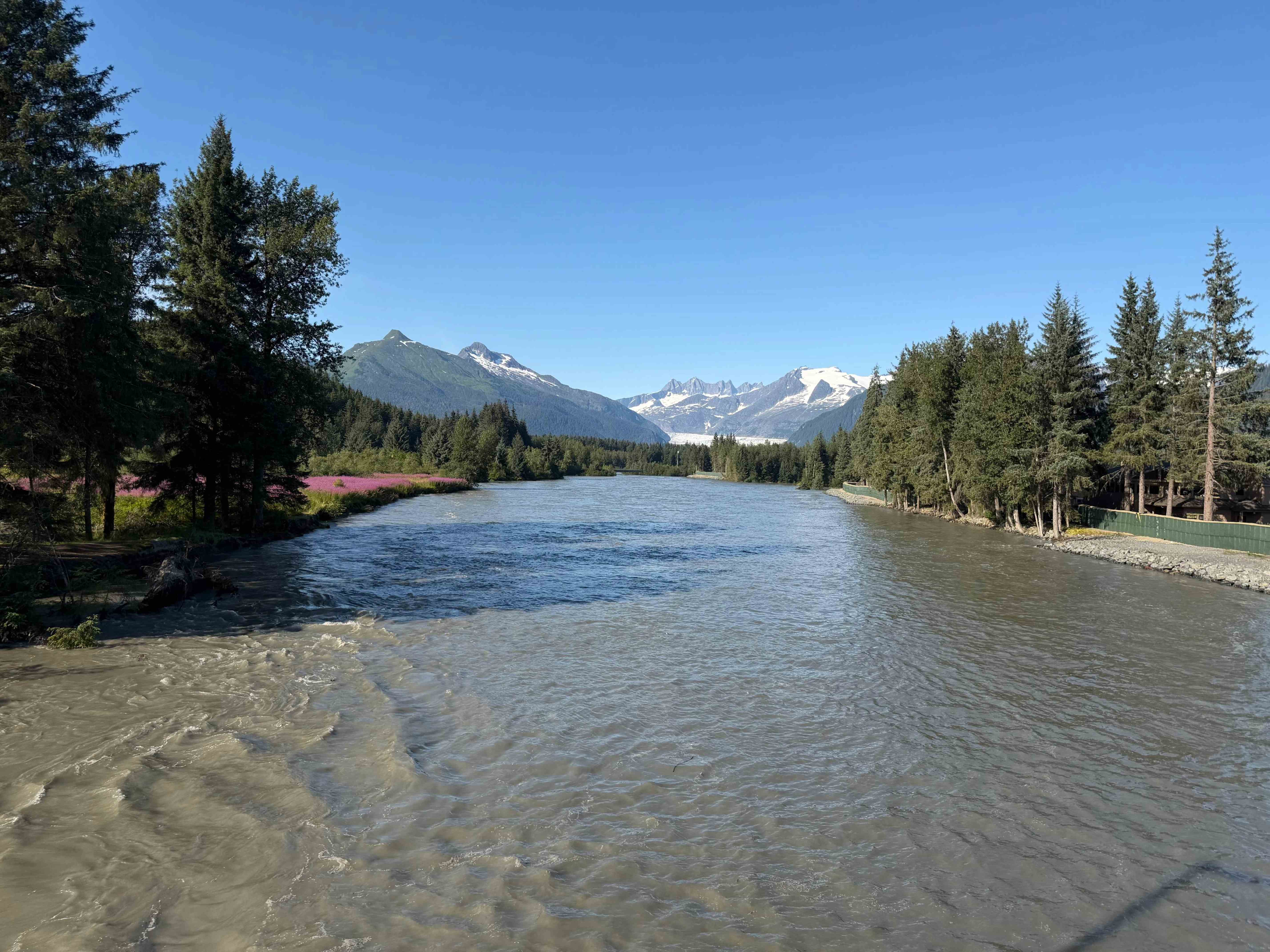
Before this year’s GLOF release on August 13, parts of Juneau were either shut down or evacuated. Accessing the river was “a bit of a fiasco,” said Jason Fellman, associate professor at UAS, director of the Alaska Coastal Rainforest Center and Alaska EPSCoR co-PI.
But, he added, people generally support his team’s research. Everyone from federal agencies to Juneau residents wants to know more about the GLOF.
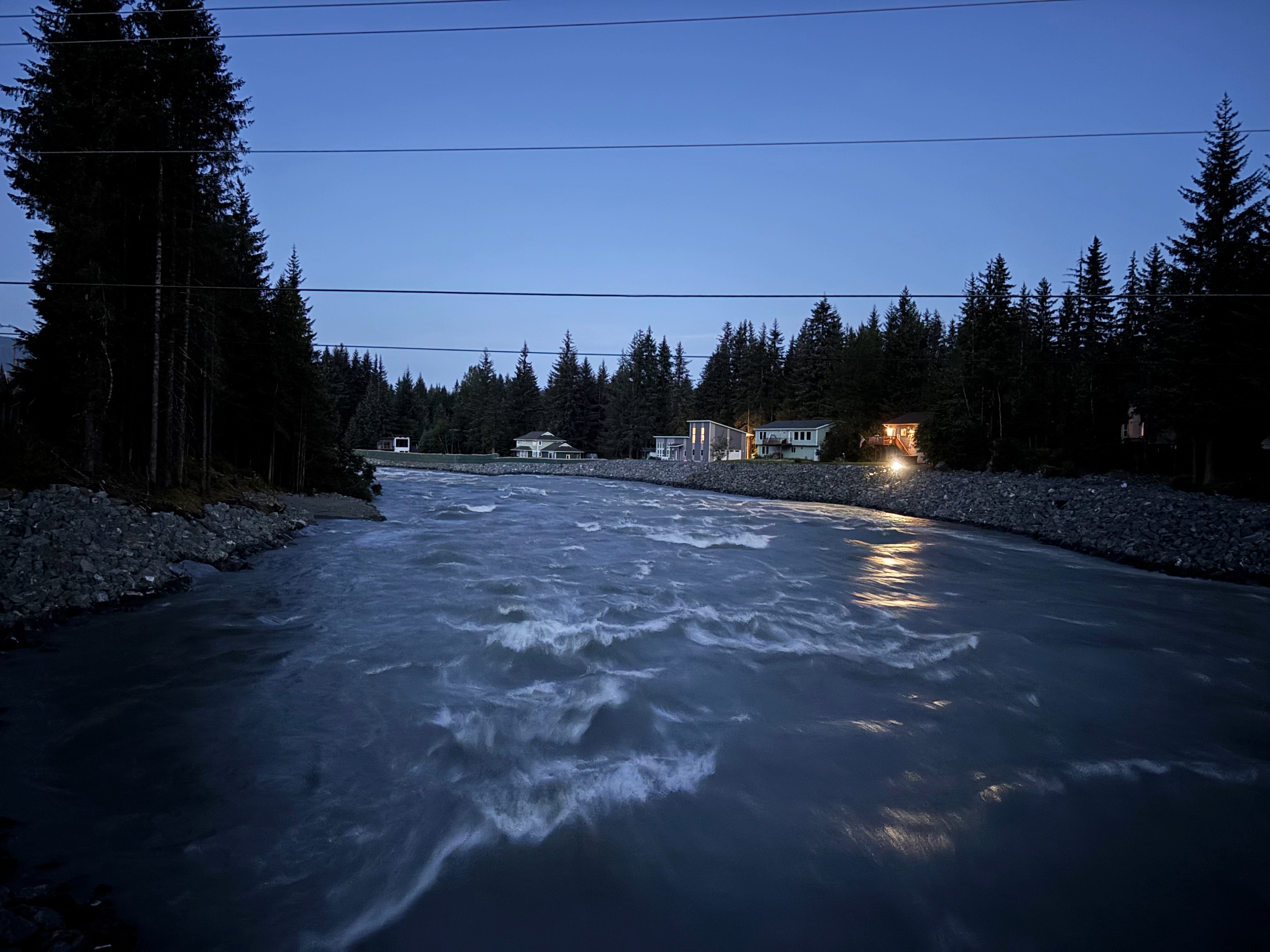
This year, Fellman and his students collected stream data by tossing a five-gallon bucket over the edge of a road bridge and hauling water up. Fellman said he’s tried more technologically advanced methods before but, he explained, “we’ve lost a fair bit of equipment over the years.”
The bucket technique fit the bill.
The team took samples every four hours for about three days. “For the most part,” Fellman said, “we were able to hopefully get what we needed.”
The Mendenhall GLOF has been occurring annually since 2011 and has been making national news since 2023, when flood levels reached historic highs and caused damage in Juneau. GLOFs are a very specific type of flood that scientists can make fairly accurate predictions about, but there remains interest in studying them as the number of GLOFs across Alaska — and their severity — may increase in coming years.
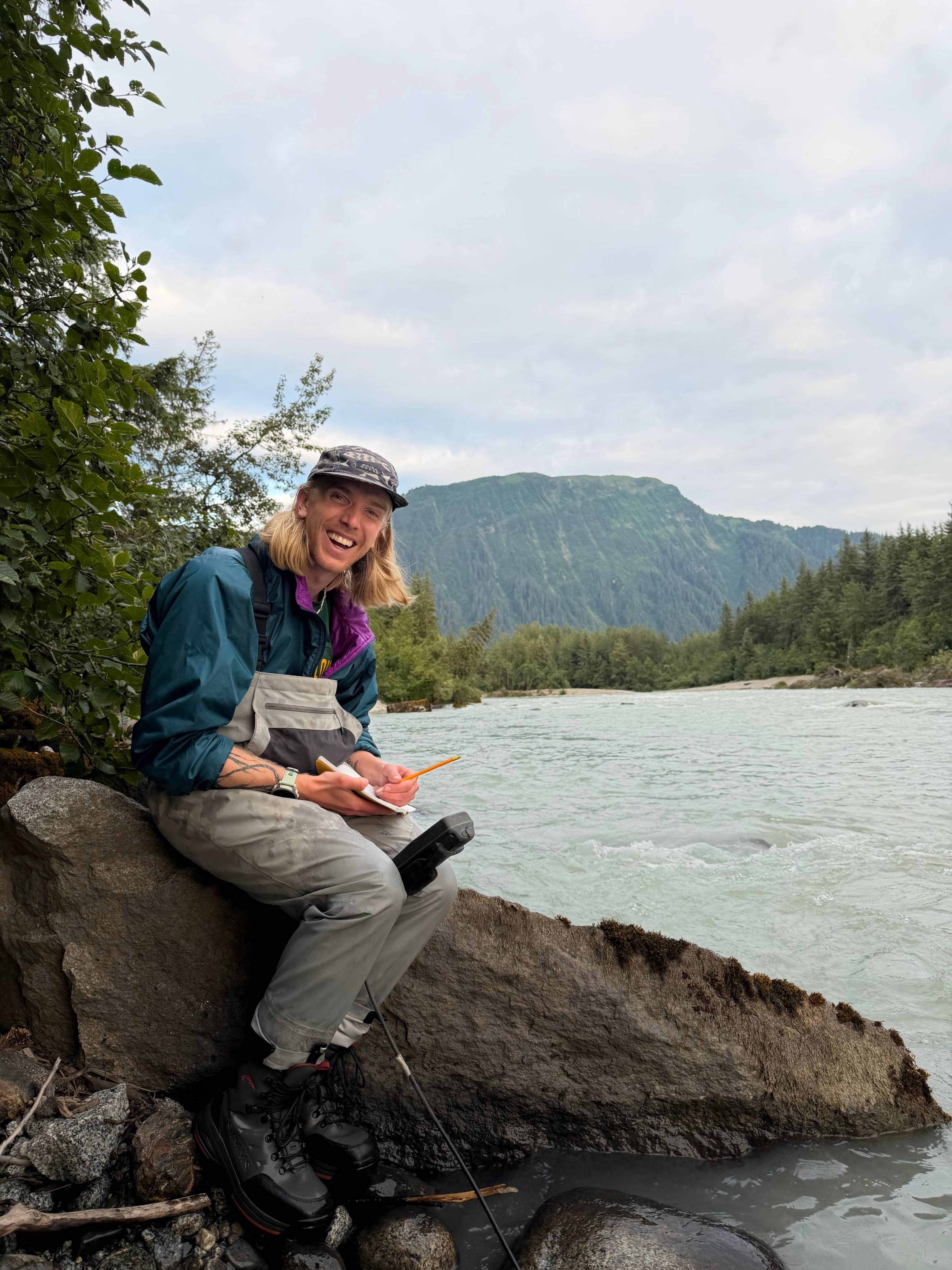
PhD student Wyatt Matyas was often on night duty while Jason Fellman's streams team sampled Mendenhall GLOF water every four hours for about three days.
Fellman, who’s part of Alaska EPSCoR’s streams team, studies the impacts of glacial change and extreme hydrologic events from the downstream perspective. He’s interested in what’s happening with the carbon, sediment and nutrient exports during such events as compared to the rest of the year. The team takes water samples regularly May through October to measure temperature, electrical conductivity, turbidity and concentrations of sediment, carbon and nutrients. They’re analyzing samples to see what percentage of annual nutrient export GLOFs are responsible for, and what that means for different glaciers.
“The relationship changes based on the amount of glacier coverage in the watershed,” Fellman explained. “If you have a watershed such as the Mendenhall, that has a very large glacier, a smaller percentage is exported during these high-flow events, compared to a watershed that has a small glacier in it. Under that scenario, more of the sediment and carbon export is happening during these storm events.”
That means that as glaciers continue to change, “things are going to be more unpredictable in that you're going to have years when you're going to have lots of massive exports of sediment associated with these rain events,” he said.
Such events may affect area mariculturists. Oysters, kelp and other farmed species could feel the pressure of added exports. And, in turn, the people raising them may have to do more work to accommodate shifts. Kelp farmers, for example, may spend more time rinsing sediment from their harvest before it can be sold.
A GLOF incites extreme sediment exports because of the flood’s mechanism. Upriver from Juneau, melt from various glaciers fills the Suicide Basin with enough water to lift the Mendenhall glacier. When the lake outbursts, water passes under the glacier before flooding Mendenhall Lake.
“When you force that much water under the glacier, you access a lot of areas that typically don't have water flowing through them,” said Eran Hood, professor of environmental science at UAS. “And that gives you the ability to mobilize a lot more sediment and other things.” He aims to understand the role GLOFs play in wiser systems when that sediment, which is normally inaccessible, is mobilized.
Hood has been pivotal to the public’s understanding GLOFs since Mendenhall’s early days. He and Jason Amundson provide much of the forecasting data for agencies like the U.S. Geological Survey and the National Weather Service and they help with operational monitoring. The pair also provides technical assistance to those concerned with human safety and infrastructure, including the City of Juneau and the Army Corps of Engineers. A third goal is educating the public around the threat of GLOFs and how that’s changing.
Now that the 2026 Mendenhall GLOF is in the rearview, the Alaska EPSCoR streams team is looking forward to what’s next.
Hood said he’s trying to develop monitoring and modeling systems that can look out for the development of potential GLOFs in other watersheds. To establish good models, the team deployed on-ice GPS units across the Mendenhall glacier to better understand how the ice is moving. That team will also continue using drones to add to its eight-year record of 3D maps of the Suicide Basin.
Beyond Juneau, Fellman has partnered with Chilkat Indian Village to monitor creeks near Klukwan that could be impacted by potential mine activity. They’ll do chemical analysis, compiling metal and toxicity data, to create a baseline data set.
Hear more from Eran Hood on the GLOF on this episode of WBUR’s Here & Now.