At the Interface of Change in the Chilkat Valley and Kachemak Bay
April 17, 2026
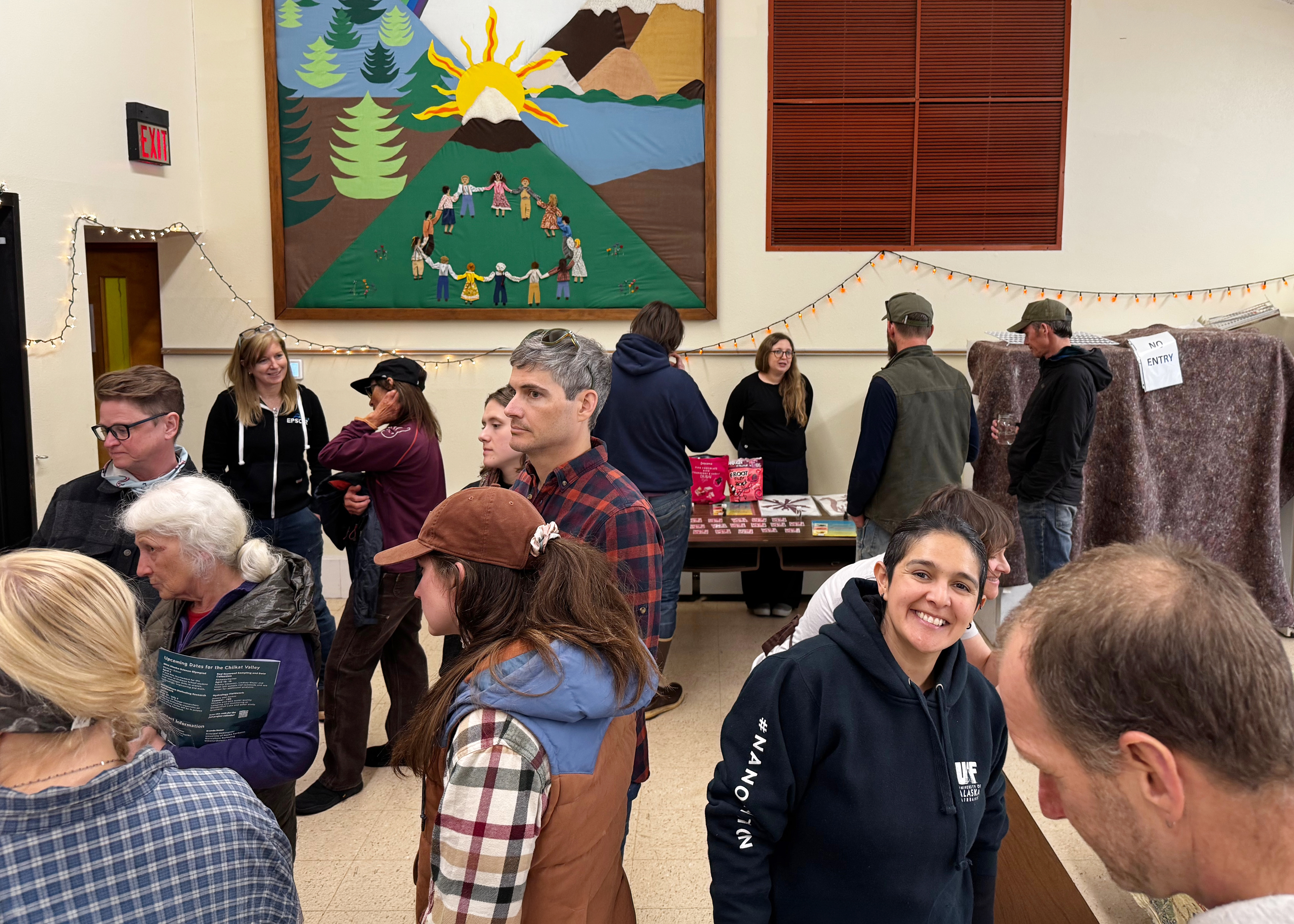
Alaska EPSCoR traveled to the Chilkat Valley and Seldovia this month to host annual community participatory workshops for the Interface of Change project as well as mini Science Olympiad events in the local schools.
Knowledge exchange between researchers and community partners is fundamental to the mission of the project. Annual community workshops provide a venue to give and receive updates on project goals. In our second year hosting annual workshops, we wanted to create a welcoming atmosphere that was both informative and fun.
We hired one of our project partners in each community where our researchers work to serve as liaisons, or “community navigators.” The idea is to have our project leadership and participants keep in contact with the community navigators to maintain respectful relations and stay in touch with community needs. Additionally, our community navigators allow us to keep a direct line open without burdening elders and Tribal leaders who already receive frequent requests for their input on myriad other projects.
Having community navigators was tremendously helpful in organizing successful community workshops this year. Haines and Klukwan community navigators Jessica Kayser Forster and Meredith Pochardt helped promote the Chilkat Valley workshops, shared insight, and connected the project with contacts for venues, such as Erika Merklin, caretaker of the Four Winds Resource Center.
Merklin was enthusiastic to help promote the event and organize a potluck for the food. She, her children, and their teammates and parents from the Haines High School Drama, Debate and Forensics team prepared food for the event. Between their cooking and the dishes people brought, the evening sported a beautiful spread of local foods, including salmon, halibut, a fiddlehead salad with herring eggs and seaweed, potato au gratin and roasted potatoes, brownies, and chocolate chip cookies. The next night at the ANB Hall local caterer offered a menu of special items including cured salmon croquette, Sitka spruce shortbread dipped in chocolate, and udon noodles.
In Seldovia, community navigator and project advisory board member Stephen Payton hosted the workshop at the Sea Otter Community Center. He put us in contact with a local chef who made a peroki, a traditional fish pie served at community gatherings, which was supplemented by a potluck.
Alongside the delightful foods, each community workshop was organized as a “science fair,” allowing workshop attendees to wander around and interact organically. Project participants organized hands-on or visual demonstrations to illustrate the project’s science and other activities. Co-PI Davin Holen acted as the workshop “MC,” helping to draw attention to some of the activities, announce door prize winners, and round up volunteers to participate in group discussions.
In the Chilkat Valley, graduate student Lindsay Meyer had a table with samples and pressings of the two red seaweed species she and researcher Schery Umanzor are studying at sites nearby. She also had memory game that she made with species IDs and photos of scenes from their field research and a one pager about the results they have found so far.
Fish biologist Matt Piche had a tank to demonstrate the concept of water turbidity, the cloudiness in water due to sediment and other suspended materials. In the tank, there were little lights. Piche then added sediment to the tank water, and people watched it cloud up. Then, stream researcher Emily Whitney had a turbidimeter and some water samples to show how she measures water turbidity.
In Seldovia, Graduate student researcher Hannah Gerrish created a display that illustrated how she ages hardshell clams and estimates their abundance as a part of her research to better understand species population dynamics in Kachemak Bay. She described the notable characteristics that indicate a clam’s maturity and how she synthesizes data for the species she studies, Littleneck and butter clams. These are critical species for the region’s subsistence way of life, but people have observed a dramatic decline in their abundance in recent years.
Photos and writing were hung for display from the Through Our Eyes participatory photography project, led by Interface of Change public health researcher Micah Hahn. Muhammad Khan and Melissa Bradle talked with Seldovia community members about their activities with local youth. Kids photograph and describe scenes of their community and environment and use these materials as a research medium to record changes they see and the importance of wild foods in their lives. After doing this project with kids in Cordova, Haines, and Klukwan, they are now working with kids in Seldovia.
People gathered around to play the virtual reality game EPSCoR staff have developed, inspired by Interface of Change. Players enjoyed roaming the virtual beach, digging for clams, and looking at seaweed growing on beach rocks. Data visualization technician Joey Hogenson guided people through the game and brainstormed ideas with people for new additions for the game as well as ideas for potential video projects.
Davin Holen, Erica Ebert, and Sean Kelly from Alaska Sea Grant facilitated group interviews on local foods with people who volunteered to participate. At each of the Chilkay Valley meetings, they gathered two groups of 6-10 people and gave prompts and questions around growing and gathering local foods, and thoughts on food security concerns for their community. One group included a number of people involved in commercial or subsistence fishing, and their conversations focused on marine topics. Another group of mostly interior Chilkat Valley residents steered the conversation more towards gardening, hunting and gathering.
Holen and Kelly structure their group interviews as sharing circles, inspired by Indigenous ways of holding a group conversation which ensure that every participant has a chance to speak.
Chilkat Valley residents expressed that they really appreciated the format of a group interview. They felt energized by the occasion to share their ideas about improving food security with a group of people from their community – ideas they may have shared before one-on-one with a friend or a neighbor, but never before with a larger group of acquaintances. People brought up ideas about creating cold storage facilities to enable the market for local seafood. Elders spoke about declining populations of salmon and other traditional subsistence species, and the importance of teaching youth how to harvest new species. Gardeners are diversifying what they grow and how they harvest. Other topics that came up included ideas about fisheries, mariculture, economic development, and how changes in weather and local hydrology threaten to increasingly damage local road infrastructure.
Alongside the community meetings, the Interface of Change team hosted a mini Science Olympiad at Klukwan School and Susan B. English School. After engaging with people at the workshops, EPSCoR team members enjoyed having the chance to spend a whole day with kids and parents, who in turn appreciated the event. One Klukwan student exclaimed, “we should have Science Olympiad day every month!”
While in town for the community workshop, researchers Erik Schoen, Matt Piche, Emily Whitney and Jason Fellman also visited research collaborators and field sites along rivers in the Chilkat Valley. This week, Schery Umanzor and Lindsay Meyer are back to visit beach sites to collect samples of red seaweeds and seawater.
The team appreciated the attendance at each of the workshops despite the gorgeous spring weather. We look forward to our next visits!