UAS-Juneau School District partnership supports hands-on marine science in 56th year of NOAA’s Sea Week programming
June 5, 2026
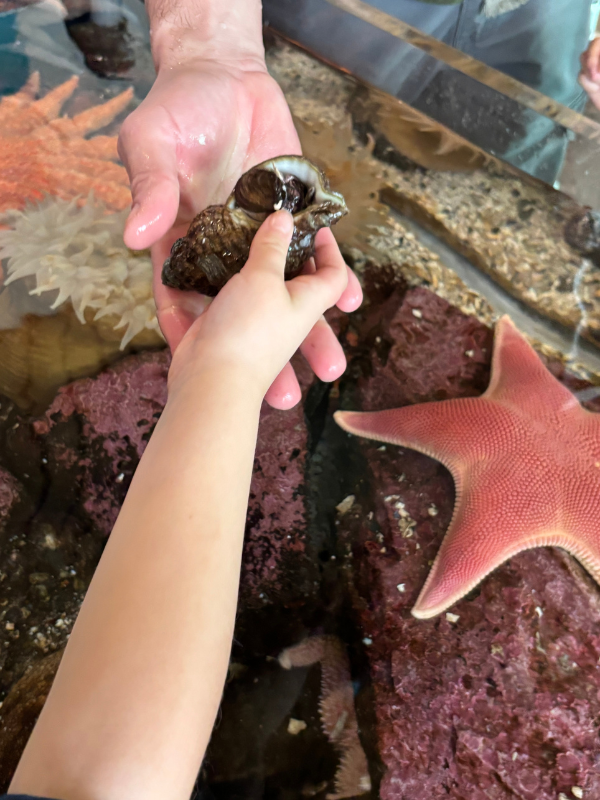
Kindergarten and sixth-grade students in Juneau explored tidepools and visited Alaska's
largest fisheries science facility during Sea Week’s 56th year, thanks to a new partnership
between the University of Alaska Southeast, NOAA Fisheries and the Juneau School District.
The partnership includes a memorandum of agreement between UAS and the school district that funded two part-time contracts for UAS student
interns to coordinate hands-on learning experiences for elementary students alongside
marine scientists from NOAA Fisheries.
The UAS students organized staff from the three partners, as well as community volunteers,
to carry out the nearly two-month-long program. In collaboration with these staff
members and volunteers, the interns facilitated classroom activities and field trips
to Juneau beaches and the NOAA Fisheries Auke Bay Laboratories at the Ted Stevens
Marine Research Institute.
“My love for the ocean began at the young age of five when my kindergarten class participated
in Sea Week,” said Chelsea Ligsay, a UAS student intern. “This one week was my favorite
week of the entire school year—running down to the tide pools in search of sea stars
and sea urchins. Now, as I pursue a degree in marine biology, I hope to give back
by sharing my love for marine life with the next generation and enabling Sea Week
to continue within our Juneau community.”
With mentorship from UAS Career Services, the interns gained practical experience
to complement their coursework in marine science, education and related fields, while
inspiring learners to better understand and protect Alaska’s marine ecosystems.
“These types of opportunities help students build skills, confidence and career readiness
while making an impact in their community,” said Stori Oates, the career services
manager at UAS. “In addition to earning academic credit, students were paid for their
work, as they gained valuable real-world experience in education, outreach and science
communication.”
The kindergarten and sixth-grade Sea Week programs currently reach about 1,200 students,
parents, teachers and volunteers annually. Field trips supplement classroom units
on animal identification, habitats, biodiversity and oceanography.
“We are excited for this new partnership with UAS to allow us to continue having our
students visit the NOAA facility," said Kristin Garot, the director of teaching and
learning for the Juneau School District. "Our teachers and students are excited each
spring to have this opportunity to learn from scientists in our community."
The agreement between UAS and the Juneau School District supported Sea Week activities
for kindergarteners and sixth graders during the 2025-2026 academic year. Once program
outcomes have been reviewed, the agreement will be updated and submitted for renewal
so students can continue hands-on ocean experiences with NOAA Fisheries staff and
facilities in future years.
Hands-on learning for elementary students and the university students who coordinate
it aligns with the UAS priority on experiential learning outlined in the 2025-2030 Strategic Plan. As Alaska’s experiential learning university, UAS offers immersive, real-world learning
opportunities in every academic program.
Sea Week began as a parent-led, weeklong effort in 1968. Today, it is coordinated
by several agencies and organizations. Sea Week activities for first through fifth
graders are organized by the U.S. Forest Service, Discovery Southeast, the Douglas
Island Pink and Chum Inc.’s Macaulay Salmon Hatchery and the Marie Drake Planetarium.
The Sea Week concept for hands-on marine and watershed learning expanded statewide
in 1985 through what is now known as Alaska Waters Education Resources—a collaboration between Alaska Sea Grant, the University of Alaska Fairbanks and
NOAA.
Read the original story here.