Did you know for the first time in UA history, Alaska Native language names will lead a university course listing?
Rebecca Lawhorne, UA System Office of Public Affairs
ralawhorne@alaska.ed
August 26, 2026
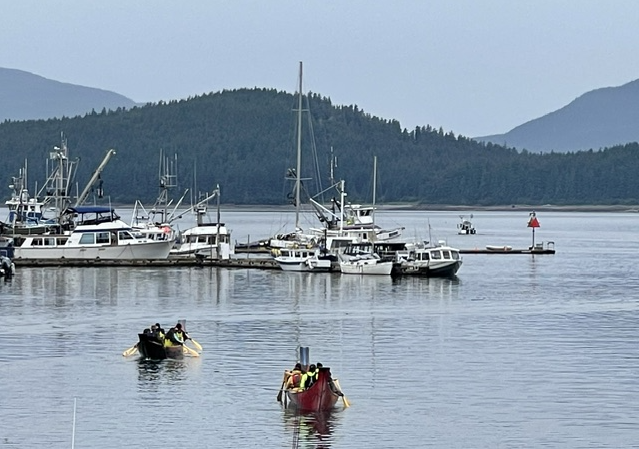
On a summer day, nine students paddled a 28-foot cedar dugout canoe through the waters off the coast of Juneau. It was the final day of Dámaan agán hl ḵíng, Take Good Care of Yourselves, a new dual enrollment course in Indigenous health and healing offered through the University of Alaska Southeast.
Last year, UAS and the Goldbelt Heritage Foundation signed a memorandum of agreement to bring a traditional canoe-carving project to the UAS campus. As that work unfolded, Goldbelt's executive director Neilg̱áa Koogéi and UAS Dean of Arts and Sciences Carin Silkaitis discussed future partnerships. Goldbelt had just received a grant centered on Indigenous wellness and health care pathways. UAS Assistant Professor of Behavioral Health Sciences Sarah Niecko was developing a plan to engage youth in health care pathways through Indigenous knowledge and healing.
Goldbelt's Youth and Education Manager Luke Fortier says the continuation of the partnership was a natural fit.
"We saw an opportunity to build on those conversations and create something meaningful, and we are grateful for the opportunity to advance what has become a really amazing partnership with the university."
The courses
The two courses will make history as the first at UAS to be listed with their Alaska Native language names first. One course is Haa Ḵusteeyí Yéi Ḵugax̱tusaneix̱, "Our Way of Life Will Heal People," in Tlingit. The other is Dámaan agán hl ḵíng, "Take Good Care of Yourselves," in Haida. The names come from Indigenous sayings. Even the registrar had to make sure the proper keyboards were available.
The choice "acknowledges our peoples, our lands, our languages," said Wendy K'ah Skaahkuwaa Todd, UAS assistant professor of Indigenous Science.
Courses will be open to the wider community in spring 2027, with a goal of enrolling up to 20 students annually. The long-term goal is an occupational endorsement or certificate in Indigenous health and healing. These courses are part of a larger program built out from UAS's Behavioral Health Program.
The pathway
The Indigenous Health and Healing Pathway is a new UAS academic program bridging Indigenous and Western approaches to health and healing. In April 2026, UAS and the Goldbelt Heritage Foundation signed a memorandum of agreement to formalize the partnership. Goldbelt is funding the initiative with $159,970 over three years. UAS provides the academic infrastructure.
"To the best of my knowledge, this is one of the first programs of its kind offered at the university level," Fortier said.
Why it matters
The Alaska Department of Labor projects more than 10,000 new health care jobs statewide by 2026. Health care workers often enter Indigenous communities without the cultural preparation to serve them effectively. Alaska Native students who could become those workers need a pathway that meets them where they are.
Niecko understands that gap firsthand. Before joining UAS, she moved to Alaska 17 years ago as a medical provider and worked in a rural Southwest Alaska village, where she was the only provider.
"As a health care provider, I quickly recognized that my formal training left significant gaps, not only in understanding Indigenous worldviews and approaches to healing, but also in acknowledging the lasting impacts of colonization and the need for trauma-informed care," she said. "This certificate, which is 100% Indigenous-led, is being created in response to that realization, not as a replacement for Western knowledge, but as an invitation to broaden and deepen our understanding of health and healing.
"I wanted to create something that wasn't a replacement for Western knowledge, but a bridge between worldviews because so many people walk in two worlds," she said. "I wish I would have had this type of training when I moved to Alaska."
"It's not just getting a job, but it's making it meaningful, and it's making it relevant and place-based to the communities that you're going to serve," she added.
How it works
The program is Indigenous-led by design. The curriculum was developed by Indigenous faculty members Todd and Judy Ramos, alongside cultural specialists Naomi Leask, Colleen James, Lyle James and Renee Culp. They determined what needed to be taught and how.
"Creating a culturally responsive framework holding both worldviews with equal value is vital," Todd said. "Seeing the whole person, physical, spiritual, emotional, mental, along with valuing cultural practices changes the system from being myopic to being holistic."
The courses are credit-bearing, open to all students, including dual-enrolled high school students, and part of UAS's new Integrative Behavioral Health bachelor's degrees.
"Students learning this essential knowledge will be empowered to enter communities with a strong foundation," Fortier said. "Building health care professionals who have that knowledge is essential."
This summer
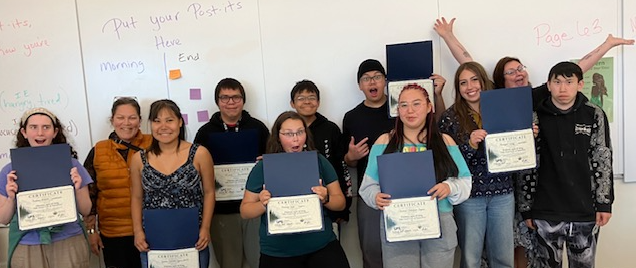
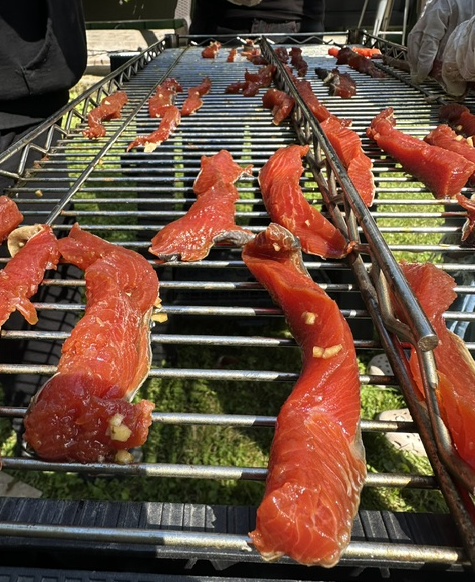
The first dual enrollment intensive ran this summer, giving students an early look at what the pathway can offer. Nine students completed the course, and roughly 90% were Alaska Native high school students. Over the week, they built earth ovens, studied plant medicine, participated in canoe journeys and explored connections between Indigenous and Western sciences.
What's next
"I would love to see UAS students earn health care-related licensures in Alaska," Fortier said. "These students would already know and be a part of the communities they are serving."
After the success of the summer intensive, UAS and the Goldbelt Heritage Foundation are discussing how to keep the partnership moving forward.
"I am seeing an incredible group of youth growing through authentic learning experiences and advancing toward dual enrollment credit," Fortier said. "I had a few students reach out to ask what is next and if there are future opportunities."
After a week of earth ovens, plant medicine and storytelling, the students carried Tlingit Master Carver and UAS Associate Professor Wayne Price's recently carved canoe to the water and stepped inside. They picked up their paddles and began to work together, timing their strokes and picking up speed.
The canoe's name, Kugaaganeix, means "Let people be healed."