Did you know the University of Alaska is a central figure in Alaska’s emerging mariculture industry?
December 16, 2025
As Alaska looks to build new industries, mariculture has emerged as one of the state’s most closely watched experiments. Still in its infancy, the sector is developing a time when Alaskan leaders are focused on building the workforce and empowering the type of industries that attract and retain talent. Encouraging signs are beginning to appear in early research, growing investment, and expanding workforce efforts. This work is forming the shape of what mariculture could become in Alaska.
Here in Alaska, the term mariculture is used to refer to shellfish and seaweed farming and excludes finfish aquaculture, which is prohibited under state law. As this industry develops, it’s becoming increasingly connected to a broader set of activities described as the blue economy, including workforce training, research and infrastructure development.
Over the past few years, investment in the sector has been growing. As Alaska Blue Economy Center Director Tommy Sheridan puts it, “It’s still very much a startup industry. We’re a few years in with the Alaska Mariculture Cluster grant,for example, and there’s a long way to go.”
Why it matters
Alaska is investing in mariculture at a moment when many of Alaska’s coastal communities
are grappling with changes in the fishing industry and looking to diversify local
economies. Building new industries in a self-sufficient manner requires local research
and training, as well as coordination across education, communities, and industry.
The University of Alaska is one of the few institutions positioned to connect all
three at a statewide scale.
Building Alaska Blue's Economy | Alaska Blue Economy Center | Tomorrow's Catch
The big picture
Across the University of Alaska system, researchers, educators, extension specialists,
and workforce programs are supporting this effort at multiple entry points. A key connector in that work
is the Alaska Blue Economy Center. Some of their work is connected to the Alaska Mariculture Cluster, a statewide effort focused on advancing mariculture and overseen by Southeast Conference, a regional economic development organization representing communities across Southeast
Alaska.
The Alaska Blue Economy Center was initiated in 2019 at the UAF College of Fisheries and Ocean Sciences as a small, nimble, and connective entity. The center was designed to link research, education, industry, and community needs.
Sheridan said that coordination is essential at this stage. “Workforce development is just one part of this,” he said. “To have a workforce, you have to have a viable industry, and that takes coordination across research, training, and communities.”
By the numbers
In 2022, the state approved a one-time $7 million appropriation to UA for mariculture research, workforce development
and industry support. This was followed by a $2 million state appropriation in the
FY26 capital budget to expand the University of Alaska Southeast’s (UAS) mariculture
program.
That same year, Southeast Conference was awarded a $49 million U.S. Economic Development
Administration Build Back Better Regional Challenge grant to support the development
of Alaska’s mariculture industry through the Alaska Mariculture Cluster.
The University of Alaska system is receiving over $11.2 million in Alaska Mariculture Cluster (AMC) funding, which includes $9.9M for workforce development programs developed by UAF, UAS, and Prince William Sound College (PWSC).
Systemwide collaboration and beyond
The Alaska Blue Economy Center connects mariculture efforts across the UA system,
linking UAF researchers with programs at the University of Alaska Southeast’s Applied Fisheries Program and workforce training at Prince William Sound College. That breeds curriculum alignment,
shared expertise, and connections between students, faculty, and industry partners.
Featuring the Applied Fisheries Program at University of Alaska Southeast in Sitka
and the Marine Natural Resources Technician Program at Prince William Sound College
in Valdez.
As Alaska’s blue economy grows, so does the opportunity for partnerships on mariculture initiatives, both in the U.S. and internationally. In October, UAS announced a partnership with the State University of New York (SUNY) at Oswego and the University of Patras in Greece.
Workforce pathways, from K–12 to postsecondary training
Students are introduced to mariculture concepts through Alaska Science Olympiad and Teaching Through Technology, which operate in roughly 15 to 18 communities statewide. These programs provide
early exposure to marine science and technology in both urban and rural settings.
At the postsecondary level, the Marine Natural Resources Technician Program at PWSC and the Applied Fisheries Program at the UAS provide hands-on training aligned with mariculture and fisheries-related work to establish early workforce pathways.
Applied mariculture research
Researchers are examining how mariculture could support Alaska beyond seafood production.
Staff at the University of Alaska Fairbanks Cooperative Extension Service at the Matanuska
Experiment Farm are studying whether Alaska-grown kelp can be used as a soil amendment to improve agricultural
productivity. Additional AMC funds have been awarded to university researchers for projects related
to seaweed tissue analysis, green energy, carbon sequestration, and species-specific
research on bull kelp, green sea urchins, Pacific dulse, and pinto abalone.
Recent greenhouse trials have tested kelp and glacial silt collected with Cordova partners, exploring whether local inputs could improve soil health, reduce reliance on imported fertilizers, and create additional markets for kelp producers.
One of the ways UA is contributing to Alaska Mariculture Cluster projects is by helping test kelp-based products for agricultural use in Alaska conditions.
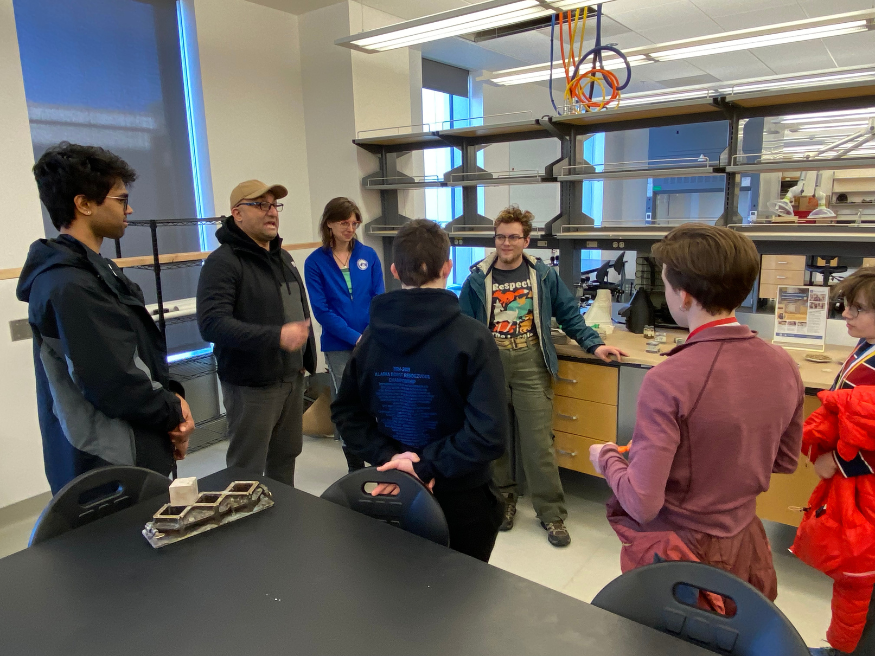
Dr. Farzadnia and ACAM graduate students Jessica McKay and Dane Woolery describing their work to the Cordova Science Olympiad students.
Infrastructure and materials research
Research is extending across disciplines. At UAF’s Automated Construction and Advanced
Materials Lab, Dr. Nima Farzadnia and his team are in the early stages of research on whether kelp can be incorporated into the construction industry, specifically,
in cement materials and 3D printing.
“We’re investigating how locally sourced kelp derivatives might enhance alternative Alaska-based cement composites designed for cold-climate and marine environments,” Farzadnia said.
Sheridan says future opportunities are likely to emerge in areas beyond traditional food markets, where the industry was largely focused in the beginning. “The opportunities with agriculture and biomaterials are big enough for a lot of people,” he said. “That’s where there’s room to grow together.”
Bottom line
The state is at a pivotal point, with increased investment and encouraging research.
The work today reflects a long view, testing ideas, training workers, and connecting
the people who will carry the blue economy forward.
Watch: Learn more about Alaska's blue economy
Program Feature: Marine Natural Resources Technician Program, Prince William Sound College
ABEC Mariculture Innovation Research Fund Project: Angie Bowers
Rebecca Lawhorne is the integrated media manager for the University of Alaska System Office of Public Affairs.